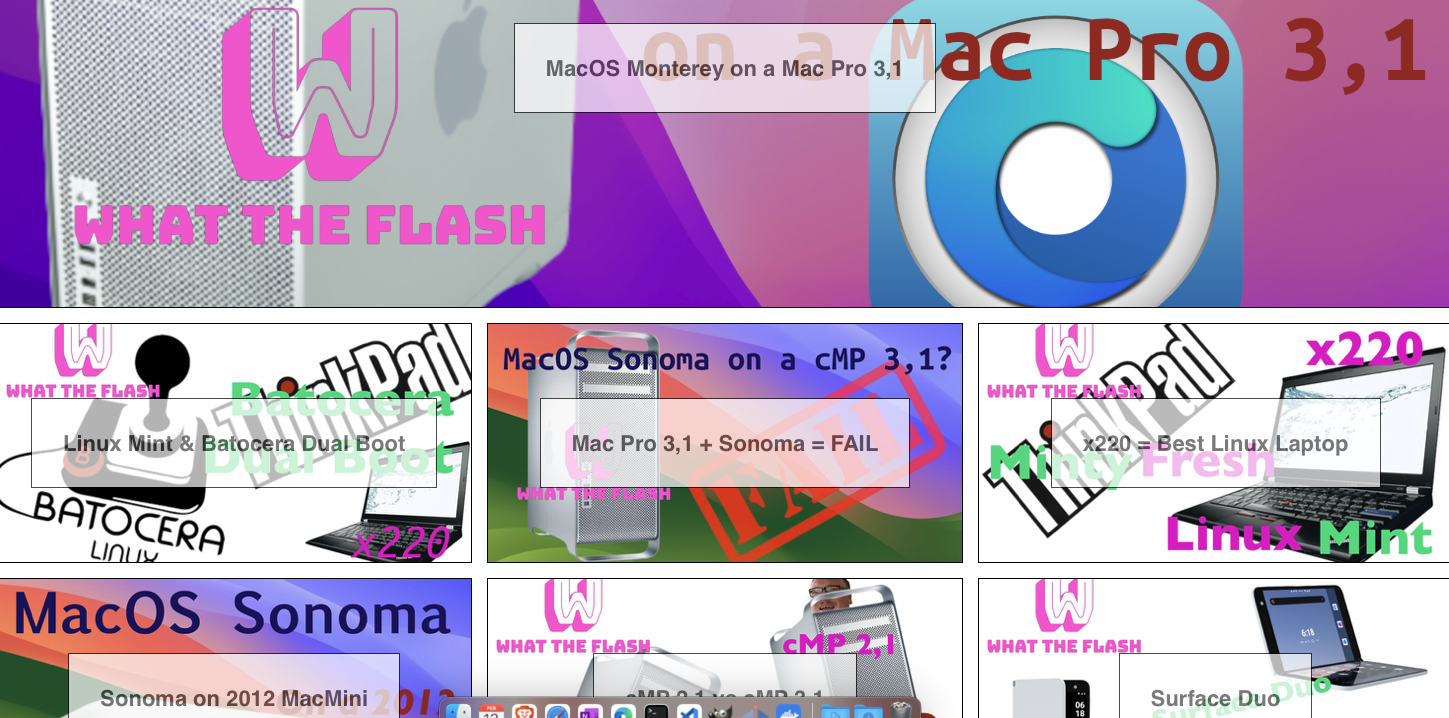
WhatTheFlash.com
I’d made a couple of attempts at YouTube before — the usual approach of uploading whatever I felt like and hoping something would stick. It never did. There was no thread, no identity, no reason for anyone to come back. WhatTheFlash was the first time I treated it as something that might actually grow if I approached it properly.
The idea was simple enough: take hardware that had been abandoned, overlooked, or written off, and see what it could still do.
- An early Intel iMac running Linux.
- A 2012 Mac Mini running a modern version of macOS via OpenCore Legacy Patcher.
- A Note10+ running LineageOS.
- An old Lenovo X220 turned into a retro gaming machine.
It leaned slightly retro, but not in a collector’s sense — more in the spirit of “this still has value if you’re willing to put the effort in”. That theme felt familiar, even if I didn’t fully recognise it at the time.
What was different this time was the structure around it.
I had an Airtable board tracking ideas from vague concept through to published video. Idea → Record → Edit → Post. Simple, but effective.
I set up a Twitter account ahead of launching anything publicly, trying to build some kind of presence before the first video even existed. I posted consistently, shared progress, tried to create the sense that something was happening — even if the audience was mostly hypothetical at that point.
There was an Instagram account too. That lasted about two posts before I realised I didn’t care enough to keep it going.
The website came out of that same mindset.
If this was going to be a thing, it needed a home — even if that home was mostly a front door pointing somewhere else.
I built WhatTheFlash.com in React, partly because it was what I knew well enough at the time, and partly because I was still trying to position myself as someone who could build with it professionally. It used React Router for navigation and Sass for styling, and I paid more attention than usual to making it feel cohesive — aligned with the branding I was using on YouTube and Twitter.
It wasn’t a complex site. A collection of videos, screenshots, short descriptions — effectively a curated window into the YouTube channel. The idea was to give people another way in, and maybe, eventually, a place for things YouTube didn’t support well. I had vague plans for a merch store, but those were gated behind platform requirements I never quite reached.
In reality, it was a traffic router. A thin layer of identity sitting in front of someone else’s platform.
Over time, the constraints shifted.The “retro pile” of hardware disappeared — partly through practicality, partly through domestic negotiation — and the content adapted. I started focusing more on the hardware I already had.
- Upgrading drives in a Synology NAS without losing data.
- Enabling LDAP on the same system.
- Looking back at devices like the Surface Duo and trying to understand why they never quite found their place.
It became less about nostalgia and more about utility. Still curiosity-driven, just applied to whatever was in reach.
Eventually, the website stopped making sense.
Renewing the domain felt unnecessary when the real activity lived on YouTube and Twitter. The site had done its job — or at least, it had explored the idea it was built to test. I let the domain go. The code still exists, deployed as a subdomain on Netlify. Not as something I actively use, but as a snapshot of a particular moment — when I was trying to connect content, platforms, and identity into something a bit more intentional.
Looking back, this wasn’t really about the site, or even the channel.
It was about structure. Taking something I’d previously approached casually and asking what would happen if I treated it like it mattered — if I gave it a process, a brand, a direction.
The same pattern shows up elsewhere if I look for it: building systems around ideas, trying to create pathways instead of one-offs, turning curiosity into something that can compound over time. I didn’t stick with it in the way I might have hoped. But I learned how I would approach it next time. And that’s probably the more useful outcome.